

Overall Approach
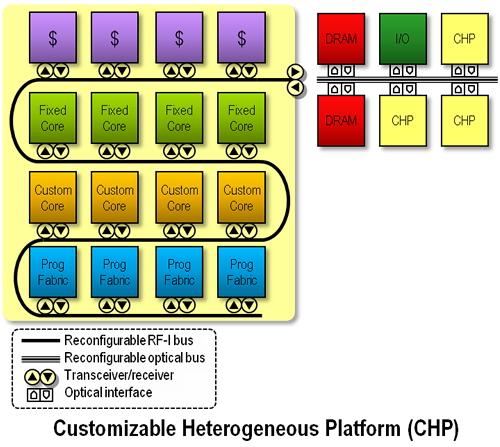
To realize the order-of-magnitude performance/power efficiency improvement via customization, yet still leverage economy of scale, we propose a Customizable Heterogeneous Platform (CHP), consisting of a heterogeneous set of adaptivecomputational resources connected with high-bandwidth, low-power non-traditional reconfigurable interconnects. Specifically, a CHP includes:
- Integration of customizable cores and co-processors that will enable power-efficient performance tuned to the specific needs of an application domain; and
- Reconfigurable high-bandwidth and low-latency on-chip and off-chip interconnects, such as RF-interconnects and possibly optical interconnect, which can be customized to specific applications or even specific phases of a given application. The following figure illustrates the proposed Customizable Heterogeneous Platform (CHP).
We propose the following three-stage approach to customizable domain-specific computing that carefully balances software and hardware considerations in the spirit of software-hardware co-design as illustrated in the following figure.
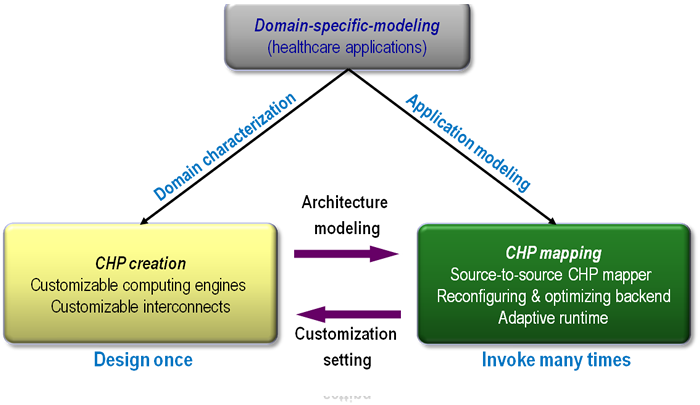
Domain-specific modeling. In the first stage, we propose to create a representative set of executable application modelsusing Domain-Specific Language Extensions (DSLEs) and a Domain-Specific Coordination Graph (DSCG) notation, both of which are designed to be accessible to domain experts. These models can be used to reveal intrinsic high-level properties of the application domain, such as intrinsic parallelism and communication topologies. This domain-specific modeling will be used as an input for the later CHP creation and CHP mapping stages.
CHP creation. In this second stage, we use the application models to design and implement an optimized set of hardware resources (CHP) for a particular application domain (or a set of related domains). The CHP creation determines how many cores, how much cache, which custom instructions, what amount of customization and reconfiguration, and what sorts of mapping transformations would be useful for customization. The decision will be driven by a set of representative applications with domain-specific modeling that specifies their computation requirements.
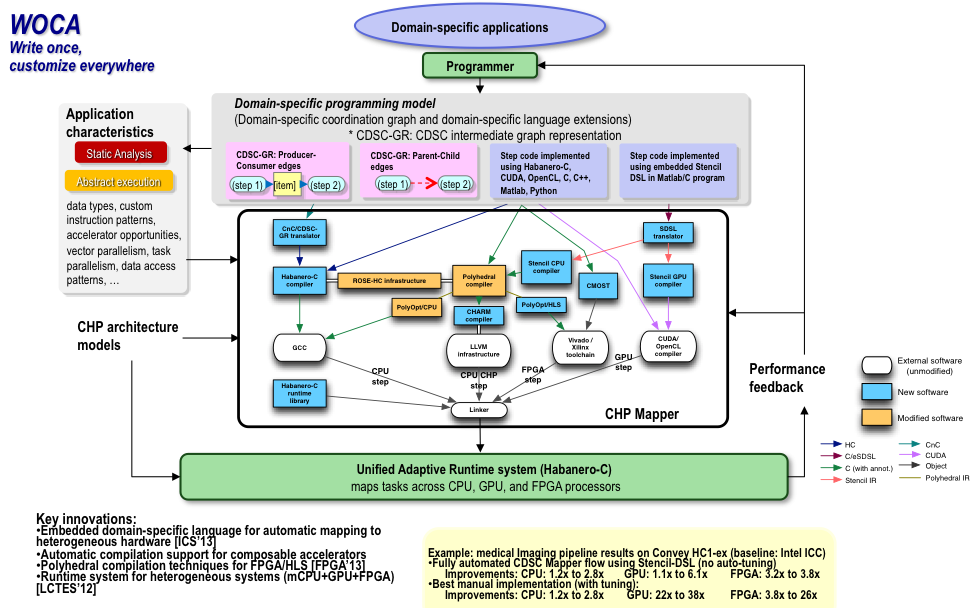
CHP mapping. Given a set of application models and an optimized CHP for a given domain, the third problem is CHPmapping, which develops domain-specific compilation and runtime systems that enable optimized mappings of the applications in the domain of the given CHP to make the best use of heterogeneous resources in the CHP. It also determines what configuration and transformation settings should be selected for configurable CHP resources in different phases of the program. The following figure illustrates the overall software stack for CHP mapping.
Application Drivers
To demonstrate the customizable domain-specific computing technologies that will be developed in this project, we choose healthcare as the application domain, given its significant impact on the national economy and quality of life (e.g., 16% of the U.S. gross domestic product was spent on healthcare in 2005). Leveraging the orders-of-magnitude computing efficiency gained from our approach, we focus on two areas: 1) revolutionizing the role of medical imaging in healthcare; and 2) realizing real-time hemodynamic flow simulations.
- Medical imaging is now a routine clinical tool in the diagnosis and treatment of most medical problems, but many advances in this field have been constrained to the research environment due to a lack of computational power. Several existing medical imaging algorithms are infeasible for real-time clinical use; and objective, automated quantitative methods that can enhance and quicken detection and assessment are not widely used.
- Likewise, hemodynamic simulations are used to understand the nature of blood flow under different pathologies (e.g., aneurysms, cardiac disease), but these models are still largely confined to the clinical research environment.
Power and cost-efficient high-performance computation in these domains will have a significant impact on healthcare in terms of preventive medicine (e.g., virtual colonoscopy for colorectal cancer screening), diagnostic procedures (e.g., automatic quantification of tumor volume for cancer diagnosis), and therapeutic procedures (e.g., for pre-surgical decision-making and monitoring/analysis during surgery).
 |
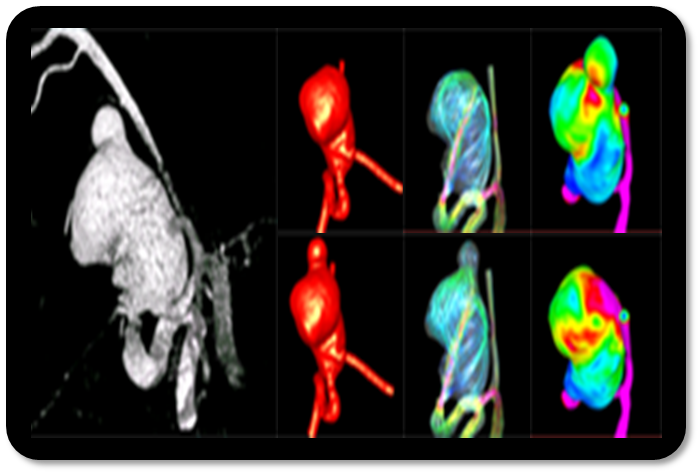 |
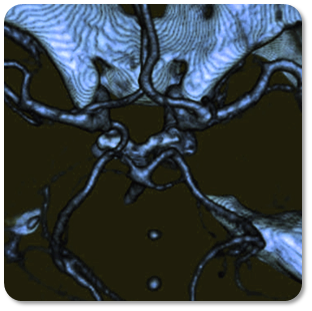
| Example: Computed tomopgrahy (CT) angiograph of an aneurysm |
Example: Intracranial aneurysm reconstruction with hemodynamics |